



Do you ever get stressed out? For example, when things don't go the way you want them to? Do you have many different files on your plate and do you find it difficult to keep an overview? Do you have concerns about things that may happen in the future but that you have little influence over?
And do these things slowly but surely turn the serene peace in your body into an annoying turmoil? Recognizable? At least for us! In our profession as consultants, we are by definition dealing with all kinds of things that can cause stress. Lots of topics, customers, projects, complexity, time pressure and so on. As an advisor, you'll learn how to deal with that. sometimes the hard way. In this article, a method that we provide to our advisors and that can help you.
Recognize your signal!
We all have those moments when you suddenly feel restless. This can manifest itself in many ways: maybe you're feeling tense or tired, sleeping poorly, noticing an increased heart rate, or worrying a lot: “What if this happens? What if that goes wrong?” Sometimes you react more emotionally than usual to small things.
No matter how it expresses itself, it's important to recognize when you end up in such a state. Because sometimes it happens unconsciously, in the background; strangely enough, you don't 'see' it so clearly. While it is there.
That's why: check in regularly with yourself. This can be done in as little as 30 seconds. What about it at the moment? Peace or unrest? Be honest. Only then can you really do something with it.
Questions to help you check in on yourself for peace or unrest:
- Do you feel peace and space, or rather overwhelm?
- Do you have an overview and does it feel manageable? Are you relaxed about it?
- Are your thoughts clear and focused, or busy and scattered?
- How do you breathe? Do you breathe calmly and deeply, or quickly and shallowly?
- Do you feel tension in the shoulders, forehead, jaws or stomach?
- Do you feel calm, irritation, stress or impatience?
- Do you make choices from an overview or in a hurry?
- Do you forget to take breaks or do you notice resistance when you stop for a moment?
And then?
When you notice that the balance is tipping more towards turmoil, the reflex is often: work harder — even harder! You try to control all your files to prevent anything from going wrong. But trust us, this seldom helps you find peace again. In fact, it's actually a form of burying your head in the sand. Working harder is only effective when there is a temporary, one-off peak. Then it makes sense to wait! But... if you catch yourself often having these kinds of peaks, you definitely have something to do structurally.
But, no worries! What does help is the opposite of working harder: taking a step back. Zoom out. Focusing. This feels exciting at first, because there is so much work to do. To help you, we have a simple method and a step-by-step plan ready for you. So that you get rest, overview and focus again. And really, it takes you less time than you think.
T model
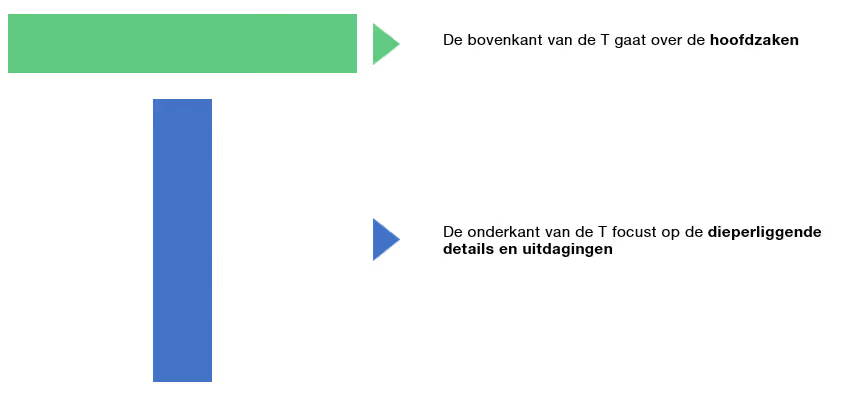
What helps us to get back to rest quickly is the T model. You can use this model to better understand your files and their status, and thus return to rest. Every file you are working on can be captured in a T.
The top of the T (the horizontal bar of the T) is about the main issues of the file. These are usually the steps in a certain order to bring the file to the desired end result.
To illustrate 'the top of the T'
The dossier “preparing dinner for four people” consists of steps:
- Check if there are any allergies
- Choose a recipe
- Buy the ingredients
- Get everything ready
- Prepare the meal
So: do you know what the main things/steps are for your file? Can you briefly and succinctly explain what needs to be done for these main issues? And do you know the current status and most important progress on this? If you don't know this for a particular file, the first step is to clarify what these steps are for this file or clarify the status.
The bottom of the T (the vertical bar of the T) focuses on deeper details and challenges.
To illustrate 'the bottom of the T'
In step 3. Buy the ingredients, you can lose yourself in the details.
- Where will you buy the ingredients? You can shop online, go to the supermarket or go to specialty stores
- What kind of ingredients do you buy? You can choose organic ingredients or not
- What ingredients are you going to buy? You can choose from a variety of brands, with one being cheaper than the others
There is a tendency to go down into the details, or to keep wandering into them
And trust us: that happens faster than you think. That's where, in the details, the real complexity of content often comes into play — and it's easy to get stuck in! That costs a lot of time. The question is:
- Is this really important NOW?
- What is the relationship with the top of the T?
- Which other T's do you have on your plate in the first place?
First, look at the whole thing. And then, only where necessary, descend into those files that matter!
This model can be applied to any file, and across all your activities. This makes it a useful model for getting your main issues (again) sharp and finding your focus again. The result? Less anxiety in your head, more peace of mind in your work. You create an overview and from there you work in a structured way on what needs to be done.
Step-by-step plan for applying the T model
You are now familiar with the T model. Applying it is just that simple! Use the step-by-step plan below to give yourself an overview and rest again. It helps you focus on what's really important — and lets the anxiety slowly subside.
Steps to overview and rest
- Take your time — Schedule an hour. That is usually more than enough.
- Find someone there — Preferably someone who knows a little bit about your situation
- Name the turmoil — Acknowledge the lack of overview. Exciting? Yes, but get some relief too!
- Perbi suit modelj — And explain it briefly to your interlocutor
- List all your T's together — What files do you have attached to your bike?
- Briefly discuss each file
- What are the most important parts of this file?
- What is the status? Can you explain that in three sentences?
- What are the biggest challenges and what do you need to do to address them?
- Check with yourself — Where are your thoughts? Where does it crash? There is a good chance that you are in depth! Then return to the top of the T. Ask your partner to challenge you on that!
- Top not clear? Then that is your priority now. Formulate actions to get the main points clear first
- Repeat this regularly — For example, weekly, or if you notice that the unrest is rising again
- And as an extra tip... do all these things really have to be done NOW? Or can something else be moved? And are you really the person who should do all that (alone)? Perhaps also worth a conversation with your manager?
And beyond?
The model and step-by-step plan help you to focus and thus experience more peace of mind. But this is just the beginning. Do you really want to work differently in a sustainable way? Then this starts with exploring your unrest. Where did it come from? What's behind it? That is an adventure in itself! 😊. Do you want to have a sparring? Feel free to send us an email!
Need help with strategy and execution?
We are Summiteers, we create movement, make something that is complex understandable again, something big achievable, a - vague - idea concrete and make something difficult succeed. Follow our LinkedIn page and get inspired.
.png)
.png)