Executing your strategy? Get your organization ready first



Why an organizational change process is usually step one
A new strategy often requires a modified organization. That sounds logical. Yet, in practice, we see how quickly organizations rush into action immediately after setting their course. The question of whether the existing organization can even execute that new strategy receives far less attention.
First, adapt your tools to the job at hand
You have established a new strategy. The ambition is clear. Perhaps you want to enter a new market, adopt a digital-first approach, move toward more centralized management, or fundamentally renew your service offering. In many organizations, the same reflex kicks in immediately: execution. We’ll set up that central management unit right away, we’ll start sales in the new segment, etc. And that almost always goes wrong. Many people see strategy execution as the phase where results become visible—the first customers, higher revenue, or developing and launching new products. But for all those results to happen, there must first be an organization in place that makes them possible.
Compare it to a Formula 1 team, where the car is adjusted to the circuit and the race strategy. The driver may be excellent and the race strategy may be spot on, but with a car tuned for the wrong circuit, winning becomes unnecessarily difficult.
The same applies to organizations. A strategy to enter a new market may require different commercial competencies, a different structure for the sales function and its connections with other departments, and different decision-making and customer processes. A strategy focused on operational excellence requires standardization, ownership, and continuous improvement. And the transition from a project-based organization to a managed-services organization requires different processes, roles, and skills.
Yet, that step is often skipped. The course changes, but the organization itself remains largely set up for the old strategy. Or, people know that "something needs to happen," but adjusting the organization is not seen as a project or process in its own right. Managers are just expected to "get it done." Friction then arises: priorities clash, responsibilities are unclear, employees lack time or competencies, and new initiatives get stuck in existing processes. Not because the strategy is inherently wrong, but because the tools don't fit the new job. The organization is not enabled to deliver. And that almost always leads to "back to the drawing board." In short: a waste of energy, time, and money.
From ambition to executable reality
At Summiteers, we view strategy execution as an iterative process of creating achievable plans and carrying them out. In our WHAT/HOW/DO approach WHAT is about the goal on the horizon and the choices you make. In HOW, you translate that ambition into a concrete and executable route. In DO, you execute, monitor, and adjust.
Enabling your organization to deliver is therefore an important part of this. Determining the "what" starts with your ambition, but also includes "where to play" and "how to win." Determining your target operating model is an integral part of the strategy. You examine what the ambition requires in terms of people, structure, processes, governance, and behavior. In short: what kind of machine do we need to realize our ambition? It will likely not be the same as the machine currently in place. So, you have to determine the "delta" and think about how to bridge the gap. Then you can get to work on changing. Designing the new organization and the plan for how to put it in place is not a technical intermediate step before the "real" execution begins. It is the first, necessary step. As soon as you start thinking and talking about that, you have effectively begun implementation.
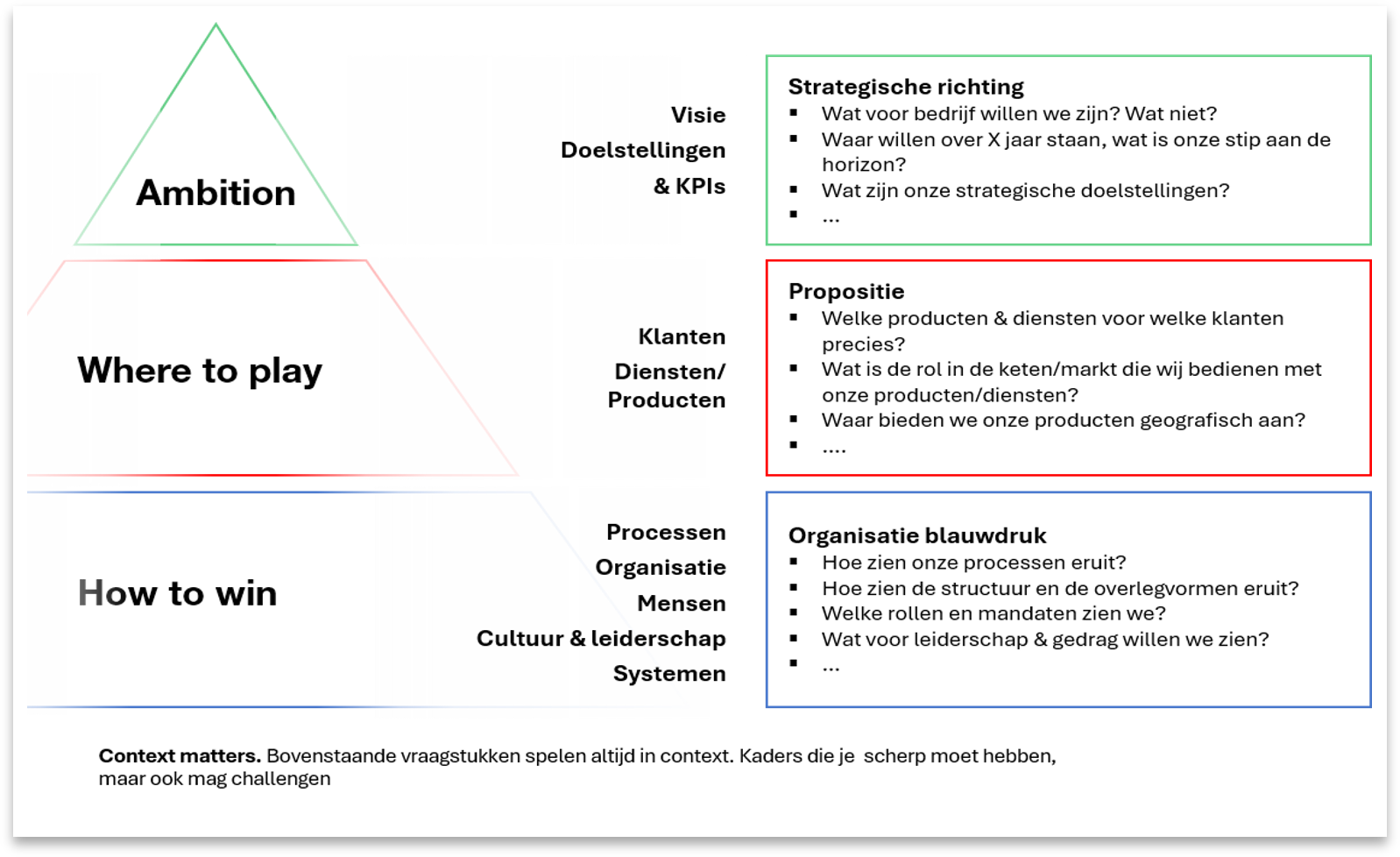
After all, a strategy is only executable when it is clear who will do what, how decisions are made, which competencies are needed, and how daily operations will support the new course. That is why you often see that the first period of strategy execution is accompanied by an organizational change process to implement the delta with your intended organization.
Suppose you want to become the gateway to China
Take a logistics organization that decides to become the gateway to Europe for Chinese companies. The temptation is great to immediately set commercial targets and send a sales team to China. That feels like execution: something visible is happening, and the organization is in motion.
But before you can scale up, more fundamental questions are needed. What exactly does "the gateway to China" mean? Which customers and propositions are you choosing? What services do they expect? What knowledge of the market, culture, and regulations do you need? Who develops the relationships? And what happens after the first customer has signed?
Perhaps a business development function in the Netherlands is needed. Perhaps the proposition requires different logistics partners, adjusted operational processes, or customer service that aligns with Chinese clients. Reporting, governance, and decision-making may also need to change.
As soon as you work out those choices and adapt the organization accordingly, you are already executing the strategy. You are making the ambition concrete and building the organization that can realize it. Only then can the line organization sustainably take over execution and can commercial results follow.
Map out the organizational delta
There is a gap between the organization you have today and the organization required by your new strategy. This delta can be small—for example, a few new or adjusted roles, training employees in new skills, or setting up a new team. Sometimes, however, a larger transformation is necessary. This occurs, for instance, when an organization or department shifts from a change-oriented focus to a run-oriented one, such as when a department must transition into a support organization after years of rolling out a major new system.
This requires a fundamentally different operating model with different responsibilities, competencies, processes, teams, and so on. Which organizational elements need to be adjusted and the scale of the change depend on both the strategy and the organization's context. There is no standard configuration; remember, structure follows strategy.
The real challenge often lies in figuring out how to bridge the gap between the current organization and the required one while keeping the business running day-to-day. This puzzle deserves significant attention: which steps to take, in what order, who to involve, how to communicate about it, and more. A sense of impatience often plays a role here. Can’t we just start selling already? Or can’t we start working in the new way right now? Such questions are very understandable and should be part of the puzzle. What is the low-hanging fruit? Can we perhaps incorporate a new way of working into the project that is driving the organizational change? This is sometimes called getting from A to B via B. This puzzle is always unique, requires a tailored approach, and therefore deserves careful attention. It is up to those responsible for strategy execution to provide that attention. This is a major success factor. Big or small, enjoyable or not, this step cannot be skipped.
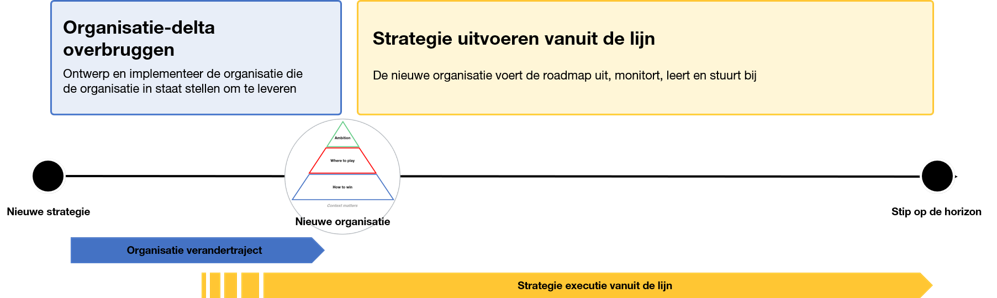
You must first properly configure your execution apparatus—the machine—to enable actual execution from within the line organization.
Sequential where necessary, parallel where possible
Does this mean you can only act once the entire organization has been redesigned? No. Executing a strategy is rarely a neatly linear process. While you are adjusting the organization, you can already be speaking with customers, building relationships, launching strategic initiatives from the roadmap, or running a pilot.
However, the sequence remains important where dependencies exist. For example, launching a major commercial campaign before the service delivery and customer support teams are prepared is not always effective and could even cause more harm than growth.
This brings us back to the plan; a good strategy includes a concrete "what" and "how." This involves creating a roadmap in which you consciously determine what must come first, what can be done in parallel, and where sequencing is important. Make dependencies visible, limit the number of simultaneous initiatives, and choose a logical pace. This prevents "starting fast" from turning into many stranded initiatives that have to be fixed later anyway.
A new strategy often means that you initially have a delta to implement within your organization. Frequently, the first period of a three-year strategy, for example, is a change trajectory designed to prepare the organization to carry out the strategic plans. And that, in itself, is already strategy execution!
Make organizational change a strategic milestone
Because the organizational delta is often viewed as preparation, it does not always receive the same attention as revenue, market share, or customer growth. That is a missed opportunity. If the new strategy depends on a different organization, then realizing that organization is a strategic result in its own right.
Therefore, formulate KPIs not only for the most important strategic objectives and results but also for measuring your organizational effectiveness and the realization of your desired organization or "target operating model."
And take a moment to recognize when the line organization is ready to take the baton. This is not just an administrative handover, but an important milestone: the car is tuned, the team knows its role, and the organization can continue to realize the course on its own. Celebrate that moment. Not because the final destination has been reached, but because a necessary condition for success has been achieved.
And once the new design is implemented, ensure that responsibility for its management is clearly assigned. We will dedicate a future article to this.
First the right organization, then sustainable results
A new strategy often requires an adapted organization. Those who jump straight to visible results run the risk that the people in the line organization who have to execute the strategy will get stuck. They haven't been enabled to do so. Therefore, start by asking what the new direction requires in terms of proposition, people, roles, processes, governance, resources, leadership, and behavior. And above all, do this together with the people who will eventually have to carry it out.
Make the organizational delta explicit. Design and implement the necessary change together with the people who have to make it happen. Sometimes these are small changes, and sometimes it requires a large-scale transformation. Look closely at what is possible, in what order, and where the dependencies lie. Only when the organization is equipped for the new strategy can the line organization execute it sustainably.
A good strategy determines where you want to go and how to get there. An effective organization makes it possible for you to actually arrive.